

Charge Ahead Tamil Nadu: Workshop on Developing EV Charging and Swapping Policy
A stakeholder consultation workshop titled “Charge Ahead Tamil Nadu” was held on 14 October 2025 at Anna Library, Chennai, to deliberate on the development of a comprehensive charging and battery swapping policy for Tamil Nadu. The workshop was organised by RMI in collaboration with the Tamil Nadu Green Climate Company (TNGCC) and the Sustainable Development Goals Coordination Centre (SDGCC). The event brought together a diverse group of stakeholders from across the electric vehicle (EV) ecosystem, including OEMs, charging point operators (CPOs), battery swapping service providers, policymakers, consultants, investors, and government officials. The objective of the workshop was to identify barriers to the deployment of EV charging and swapping infrastructure in Tamil Nadu and explore policy measures to address these challenges.
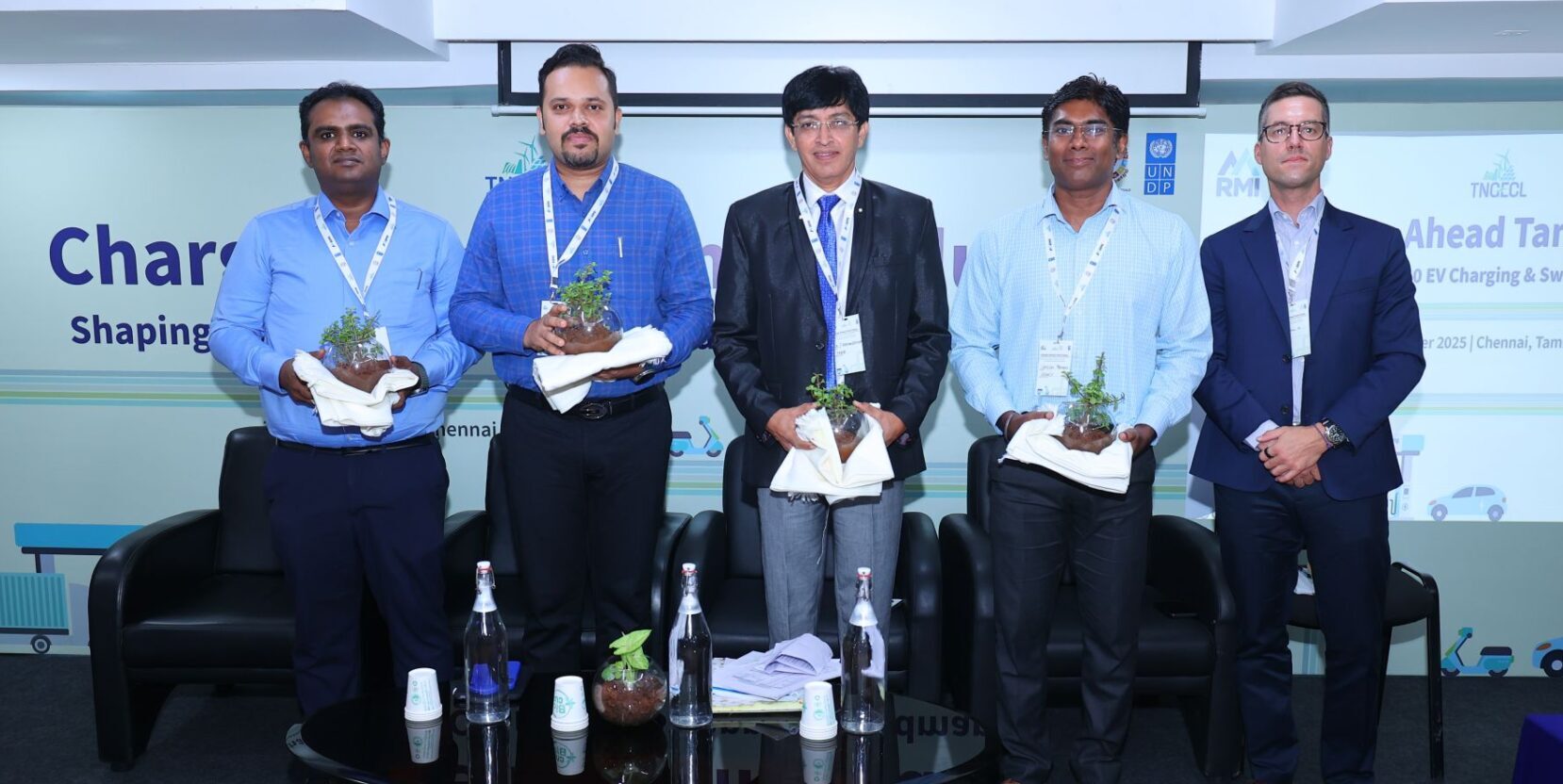
The workshop began with welcome remarks by Mr. Satish Menon, Chief Development Goals Specialist, SDGCC, who set the context for the discussions and highlighted the importance of coordinated action to support Tamil Nadu’s EV transition. Followed by remarks on the State’s interventions in the EV sector by Dr. Aneesh Shekhar, IAS, Managing Director, Tamil Nadu Green Energy Corporation Limited (TNGECL).
Special remarks were delivered by Thiru. A.R. Rahul Nadh, IAS, Director, Department of Environment and Climate Change, emphasizing the role of policy alignment and institutional support in accelerating clean mobility initiatives. The keynote address on Tamil Nadu’s EV vision was delivered by Dr. J. Radhakrishnan, IAS, Chairman and Managing Director, Tamil Nadu Electricity Board (TNEB). He highlighted the State’s long-term strategy for EV adoption and the need for robust charging and energy infrastructure to support this transition. Mr. Dimpy Suneja, Manager, RMI India, presented the Draft Tamil Nadu Charging and Swapping Strategy, outlining current gaps, modelling insights, and the proposed strategic pillars for building a scalable and efficient EV charging and battery swapping network across the State. Mr Satish S, Fund Manager -TNGCF, Mr Lino, Associate – TNGCF and Mr Jeyanth Sankar – Fellow Analyst – TNGCF participated in the discussions.
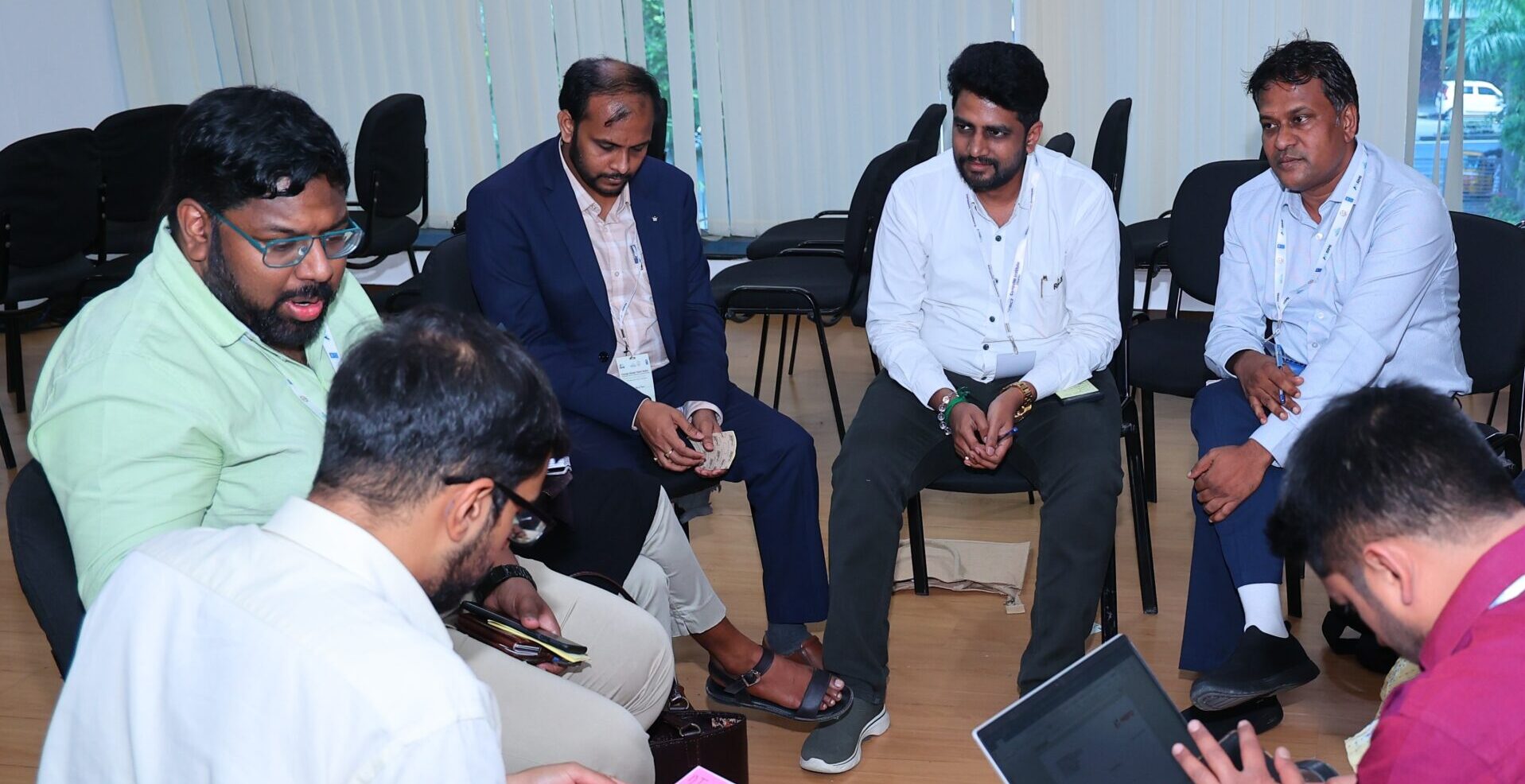
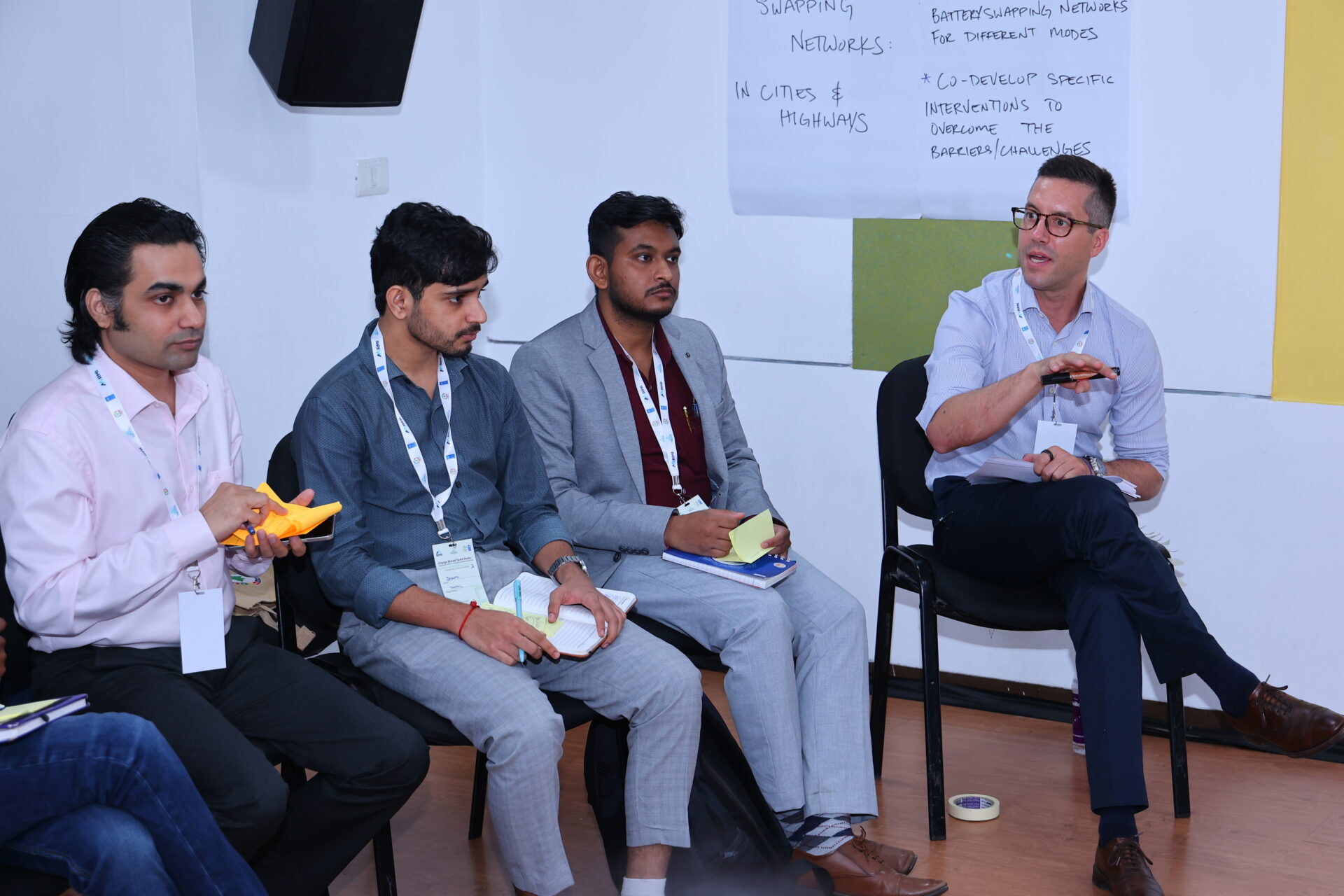
The workshop featured three parallel group discussions that focused on key thematic areas: Urban Charging Infrastructure:
• Challenges and opportunities for setting up public and semi-public charging facilities in cities.
• Highway Electrification and Corridor Development: Strategies for enabling seamless long-distance EV travel through charging corridors.
• Battery Swapping Networks: Development of swapping infrastructure in urban and highway contexts.
Participants also discussed critical cross-cutting issues, including Financial and economic barriers, such as limited incentives for setting up battery swapping stations and low consumer uptake of swappable EV models. Institutional and regulatory challenges, including the need for subsidies for upstream infrastructure costs, tax incentives for swappable EV purchases, and government support for land and demand aggregation. Infrastructure and power-related barriers, particularly high capital costs and concerns around grid stability affecting station viability.